

As the monsoon rains lashed the country and our rebuild plans ground to a halt until the dry weather returned, the political parties finally came together to find consensus on the long awaited new Constitution of Nepal – something that has been eluding them for the last 8 years! Hurrah we all thought, finally something positive to come from the tragedy that was April and May’s earthquakes. Sadly, not everyone felt the same and some of the ethnic groups from the Terai voiced their dismay at their perceived marginalisation within the proposed Constitution by organising strikes as a means of protest, causing chaos and disruption to the regions bordering India. As the protests heated up, some resorted to violence and sadly, lives were lost. The Constituent Assembly unperturbed by this, continued with the drafting of this new and historic document and it was finally brought into law on the 20th September, replacing the interim constitution of 2007. The Government announced a two-day holiday to mark the event and people across the country celebrated in the hope that the new Constitution would pave the way for the stability and progress the country so badly needs and its citizens crave.
Alas this was not to be, as things moved from bad to worse down in the Terai region with the agitating parties increasing their protests by blockading the trade entry points from India to Nepal – points that Nepal relies on for the supply of all fuel, as well as many other essential supplies.
Slowly queues began to appear at petrol pumps, as supplies were not able to get through, but nobody expected them to last long as the police got to grips with the situation. Oh, how wrong we were. To make matters worse, despite assurances from the police and army that all goods vehicles crossing from India to Nepal would be given safe passage, India refused to refill the fuel tankers citing security issues, thus starting what has been called in the media the ‘unofficial Indian blockade’, a blockade that India vehemently denies.
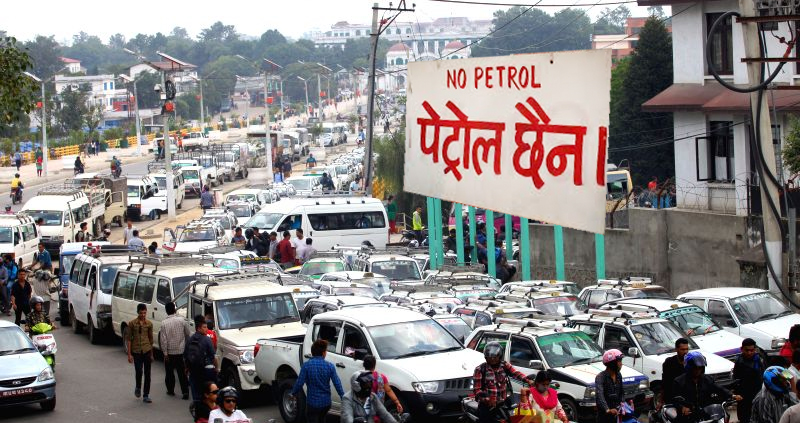
The long and the short of the situation is that Nepal is slowly being brought to its knees by the crisis, which has been running for 3+ weeks now. There is insufficient petrol, diesel and aviation fuel to meet the demand. Initially fuel saving measures were put in place to try and reduce the demand, however these were not enough and over 2 weeks ago private vehicles were banned from refueling and commercial vehicles severely rationed. Petrol pump queues snake for mile and miles often 3 or 4 vehicles deep as people struggle to keep their vehicles moving. International airlines are having to refuel in a 3rd country as there are insufficient stocks to allow refueling in Kathmandu. New bottles of cooking gas are non-existent in the market place as is kerosene and people are eking out what little they have for as long as they can. Businesses and industries are closing, children are missing school, food shortages are beginning to show in the market place and prices are skyrocketing due to the ongoing situation.

Vehicles and bikes queue for hours on end in the hope of receiving some fuel (photo: onlinecanadanepal)

The crisis has also caused an acute shortage of cooking gas (photo: Raino Nepal)

The few micros and buses that are running, are packed both inside and out!
Sadly, with the new constitution in place, the Government of Nepal was more interested in electing a new Prime Minister than dealing with the escalating situation, and only now that there is a new one in residence, are they slowly beginning to show signs of addressing the crisis.
With all this happening in the background, our plans to crack on with starting to build permanent classrooms and health posts have been severely curtailed. We have not been totally idle however, and despite it taking much longer than anticipated, we have just received official permissions and plans for a permanent 3-classroom building for Shree Upallo Pekhu Secondary School in Syangja District. All we need now is for the situation to get back to normal, so not only can we source the materials we need for the build, but get them to school as well!

Approved elevations for the 3-room building

Cross section of the approved building