

The devastation was as vast and as jaw dropping as the beauty that surrounded it. Not a single building survived last April and May’s devastating earthquakes. The traditional stone and slate houses that had once seemed so sturdy, a natural part of the landscape were no longer recognisable. Ancient villages returned to the earth and replaced by tin and tarpaulin shelters.

Locals slowly rebuilding each home, one by one
In the immediate aftermath of last year’s earthquakes, some aid reached Baruwa. Tin sheets were distributed, toilet tents provided and the local school was relocated and replaced with some temporary learning centers. However, as with so many natural disasters, when the international disaster response agencies pack up and leave, so does the hope of the locals. They are left to deal with a catastrophe that reaches far beyond the loss of homes and possessions, to regroup as a community and quite literally to start rebuilding their lives.
This was HQ’s second visit to Baruwa (blog post #19). This time instead of going alone, we headed a team consisting of leading American expert in disaster/trauma management and care, Lisa LaDue and forensic psychologist Katie Carroccia from Lion Path International (www.lionpath.org) and transpersonal psychologist/yoga therapist YogaTara from Kathmandu’s Isha Centre (www.ishacentre.com).

The Team
The purpose of this visit was to take a team of trauma experts to work with the local health providers and teachers to understand trauma, the effects it has, and how to renegotiate its effects using Somatic Experiencing, a psychobiological approach to relieving and resolving the effects of trauma with the aim of giving them information, understanding and practical tools to better take care of themselves and others in, and after, times of hardship.
After a long and somewhat precarious journey to the village along a single track dirt road made of ruts, dust and slippery patches, with landslide prone cliffs on one side and a long and perilous drop on the other, we finally arrived in the village in the dark to the welcome sight of our tents already set up and dinner almost ready. Given the state of the village, it was important that we were self-sufficient and didn’t place additional stress on the community we had come to help.

Camping amongst the rubble
With full bellies and tired from the long and bumpy journey, we finally crawled into our tents (pitched on the cleared space where a house had previously stood) anxious to be fresh for the following days workshop. And then it happened. Mother Earth’s reminder of why we were there, a 4.6 magnitude aftershock directly beneath us – the epicenter, Sindapulchowk. The 430th aftershock with a magnitude of 4 or more since the April 25th earthquake, and the 125th for Sindapulchowk, not including all those not officially registered.
The next morning, with the aftershock reverberating in our bodies, we headed up to the school. The participants slowly arrived, some who had walked for as long as 4 hours to attend. As is usual, it took them a little time to relax and begin to open up. Most had little understanding of what they were going to learn, but were hopeful of new knowledge that would help them comprehend what they were going through. Every face reflected in some way the fear and tragedy they had all suffered and were still suffering from. Some twitchy and agitated, others in a state of freeze, faces and eyes blank as they struggled to come to terms with what had happened and the day-to-day business of living.

In total there were about 21 participants in the workshop, ranging from teachers, health workers, youth club members, local community members and an NGO worker
As is often the case, not as much was covered as was planned. To see the understanding in their faces and the realisation that what they were feeling was normal when shown a graph depicting the stages one goes through after a disaster, dispelled any last doubts about whether what was being taught was truly helping or not. Everyone one in that room could pinpoint where they were on the graph and where they headed back to each time a tremor hit. Everyone in that room could identify with the three main states the body goes into when it receives a shock, or is subject to trauma, fight, flight or freeze and could relate it back to either themselves or someone they knew. Everyone in that room was able to walk away at the end of the day, with some basic tools to help them and others ground, reorient and stabilise themselves.

Stages of a disaster

Participants simulating skipping as an exercise to show them how their body feels/reacts with exercise and how these feelings can be similar to those they feel during/after an aftershock
Even with this minimal, new knowledge you could see them take strength from it. Take strength from the fact they were not alone in their feelings. Take strength from the fact that their reactions were normal. Take strength from the fact that they now had some simple tools to help them slowly, slowly work on their bodies in the hope of eventually reaching some state of calm.
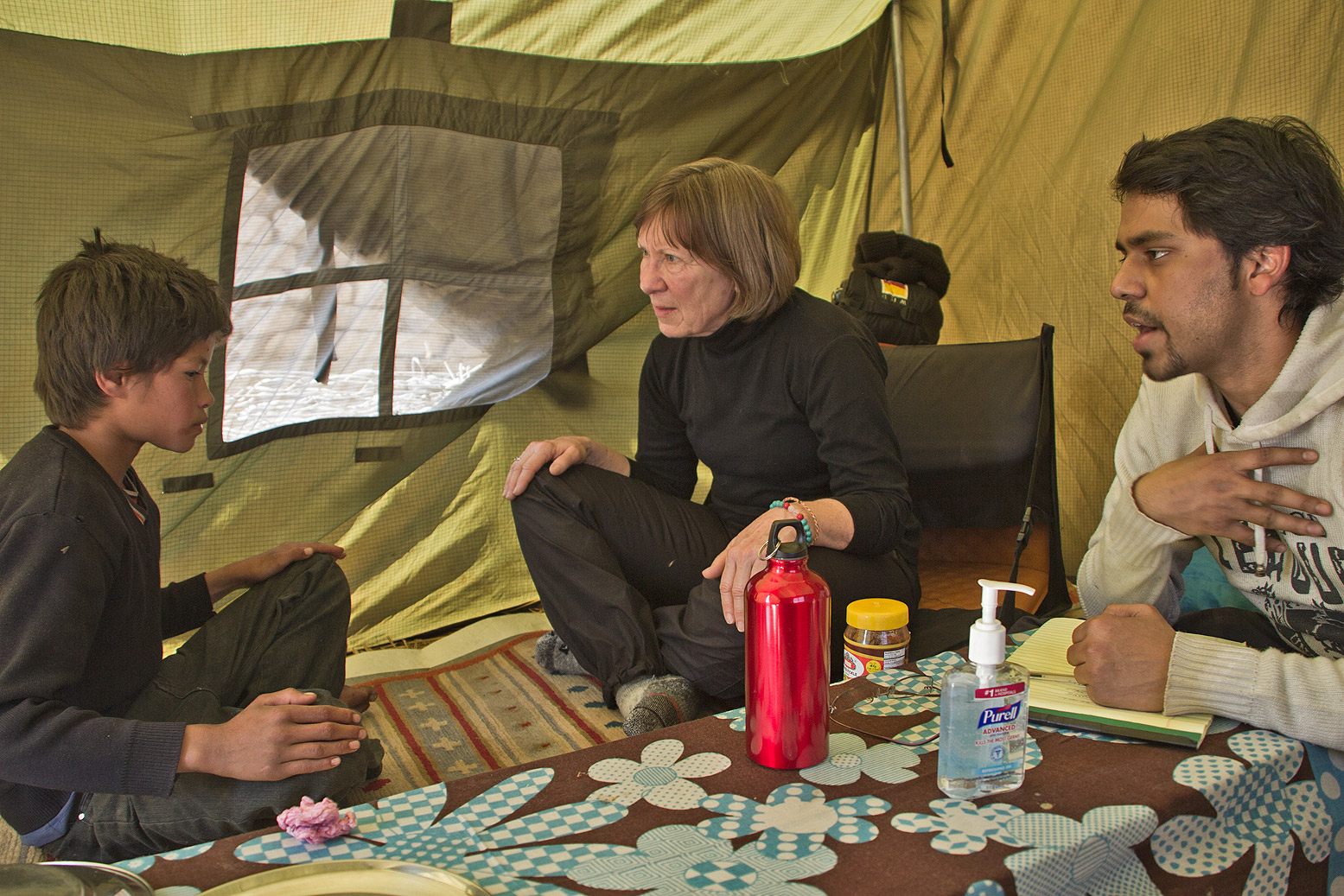
On the following morning, before we packed up and headed back to Kathmandu, Lisa and Katie held some one on one sessions for those who requested them, enabling them to go a little deeper with each individual and to show them that calm and release is possible, even if only for a couple of minutes at a time. The impact of these sessions on each person was transforming, with states of calm, quiet, release and momentary relaxation achieved by all.

This elderly lady was finally able to find a short period of stillness and quiet with Lisa

In just one session with Lisa, this head teacher was able to glimpse a path to recovery, and took strength and hope from it

When this mother found her moment of calm supported by Katie, her nursing child also relaxed and stopped crying, the release, directly affecting them both
Everything aside, the biggest affirmation for us that there is not only a need for this kind of help but a desire from the locals to be helped, was their request for us to return and continue the work we had started so they can reach out and help not only themselves but others as well. A request we intend to honour, and the team is already planning fundraising events and grant applications to help cover the costs of getting the team over from the USA, as well as all the in-country costs, with a tentative return date set for the autumn.
Before this however, HQ will be returning in May to hold a 2-day health camp at the health post that we are helping rebuild.

Baruwa health post
Many thanks to everyone who helped make these workshops a possibilty. Pasang Tamang from Baruwa for liaising with the locals; Lisa and Katie for giving up their time to come to Nepal and for sharing their expertise; YogaTara from the Isha Centre for initiating and helping fund the sessions; Drs Akhilesh Thakur and Bishal Gaywali for being wonderful interpreters; Dawa Sherpa and Saroj Ale for keeping camp and feeding us so wonderfully and finally, all our donors across the globe who continue to trust us and support the work we are doing.